The Arbitrage Illusion: Why Bitcoin Price Gaps Between US Exchanges Almost Never Pay Off

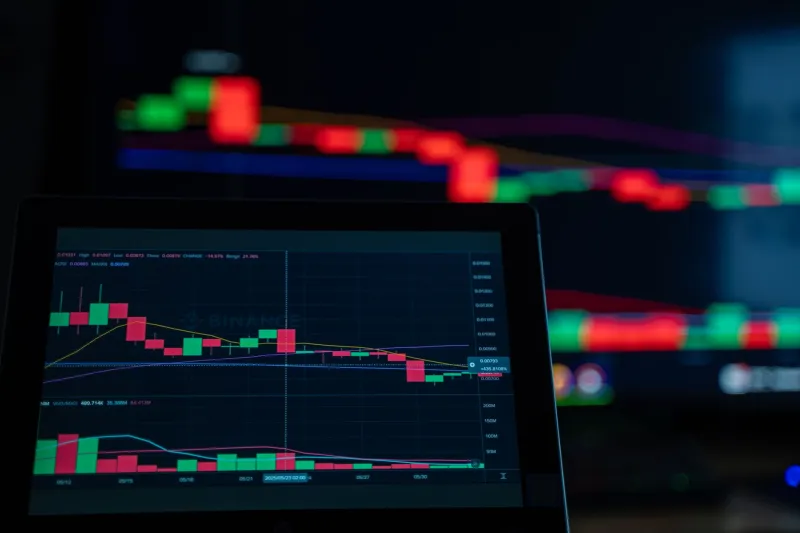
Photo: bitcoin price comparison multiple exchanges trading screens data, via img.observatornews.ro
Price discrepancies in financial markets are supposed to be self-correcting. When an asset trades cheaper on one venue than another, arbitrageurs buy the lower price and sell the higher one simultaneously, pocketing the difference and pushing prices back into alignment. This mechanism functions efficiently in equity markets, where institutional players execute cross-venue strategies in microseconds with institutional-grade infrastructure.
Bitcoin markets tell a more complicated story. Price differences across major US exchanges — Coinbase, Kraken, Gemini, and others — do appear regularly, sometimes reaching $50, $100, or more per coin during periods of volatility. To a retail trader monitoring multiple price feeds simultaneously, these gaps look like an obvious opportunity. They are not. Not for the vast majority of individual market participants.
Where the Price Gaps Actually Come From
Before evaluating whether arbitrage is viable, it is worth understanding why these discrepancies exist at all.
Each exchange operates an independent order book. Liquidity is not shared between platforms. When a large market order hits Coinbase's book and absorbs available sell-side liquidity, the price on Coinbase can move sharply upward while Kraken's book — which did not absorb the same order — remains unmoved for several seconds or longer. The gap reflects the time it takes for information to propagate and for market participants to act across venues.
Additionally, each exchange serves a somewhat different customer base, carries different maker-taker fee structures, and processes withdrawals at different speeds. These structural differences mean that even after information has propagated, the cost of bridging the two venues can exceed the price difference itself.
The True Cost of a Cross-Exchange Trade: A Worked Example
Consider a scenario that appears genuinely attractive on the surface. Bitcoin is quoted at $67,000 on Kraken and $67,180 on Coinbase — a spread of $180 per coin. A retail trader with $10,000 available on Kraken decides to buy there and sell on Coinbase to capture the $180 difference.
Step one: Purchase on Kraken. A market order at $67,000 triggers a taker fee of approximately 0.26% on Kraken for a standard retail account. On a $10,000 purchase, that fee is $26.00. Slippage on a market order — the difference between the quoted price and the actual fill price — adds another $15 to $30 depending on order book depth at the moment of execution.
Step two: Withdraw Bitcoin from Kraken. Kraken charges a fixed network fee for Bitcoin withdrawals. At current network conditions, this ranges from $1.00 to $10.00 or more depending on mempool congestion. More critically, the withdrawal itself requires blockchain confirmation. At standard confirmation settings, this takes 10 to 40 minutes.
Step three: Sell on Coinbase. By the time the Bitcoin arrives in the Coinbase wallet, 20 to 40 minutes have elapsed. The $180 spread that existed at the moment of the Kraken purchase may have narrowed to $30, reversed entirely, or disappeared. Assuming it persists — an optimistic assumption — the Coinbase taker fee of approximately 0.60% on $10,180 adds another $61.08. Slippage on the sell side adds a further $15 to $30.
The arithmetic: Starting with a $180 gross spread, subtract $26 in Kraken fees, $20 in slippage on the buy, $5 in network withdrawal fees, $61 in Coinbase fees, and $20 in slippage on the sell. Total friction costs: approximately $132. Remaining profit: approximately $48 — on a $10,000 position, assuming the spread has not moved against you during the settlement window.
That $48 represents a 0.48% return on capital, achieved over 30 to 45 minutes of active execution, with substantial execution risk baked in. It is not a viable business.
Why Institutional Arbitrageurs Don't Solve This for You
A natural follow-up question is why institutional participants don't simply arbitrage these gaps away more efficiently, eliminating the opportunity for retail traders while also compressing the spreads.
The answer is that some arbitrage does occur at the institutional level — firms maintaining pre-funded accounts on multiple exchanges simultaneously can execute near-instantaneous cross-venue trades without blockchain settlement delays. These players operate at a structural advantage that retail participants cannot replicate. Their activity does compress spreads over time, but it cannot eliminate them entirely because the underlying liquidity fragmentation between venues is a permanent feature of the current market structure.
For retail traders, the practical implication is that the spreads visible on price comparison tools are largely pre-arbitraged opportunities that already reflect the cost of institutional execution. The residual gap is not free money — it is compensation for the friction and risk that institutional arbitrageurs have already priced.
Withdrawal Limits Add Another Layer of Constraint
Beyond fees and timing, withdrawal limits impose a hard ceiling on cross-exchange strategies. Most US exchanges impose daily withdrawal limits that vary by verification tier. A trader who has not completed enhanced identity verification may find that their withdrawal capacity is capped well below the position size required to make the strategy economically meaningful.
Even fully verified accounts face limits that restrict how much capital can be moved in a 24-hour window. For a strategy that depends on rapidly deploying capital wherever the spread appears, these limits function as a structural barrier.
What Retail Traders Can Do Instead
Rather than pursuing cross-exchange arbitrage directly, retail participants can extract value from exchange-specific dynamics in less friction-intensive ways. Monitoring spread patterns across platforms can provide useful signals about order flow imbalances and short-term directional pressure. When one exchange is consistently pricing Bitcoin at a premium, it often reflects concentrated buying interest that may presage broader market moves.
For traders focused on execution quality, routing orders to the exchange offering the tightest spread and deepest liquidity at a given moment — rather than attempting to exploit the difference — is a more practical application of the same market intelligence.
The arbitrage gap is real. The profit from chasing it, for most US retail traders, is not.