Ghost Volume: Separating Real Bitcoin Buying Pressure From Stablecoin Rotation Noise
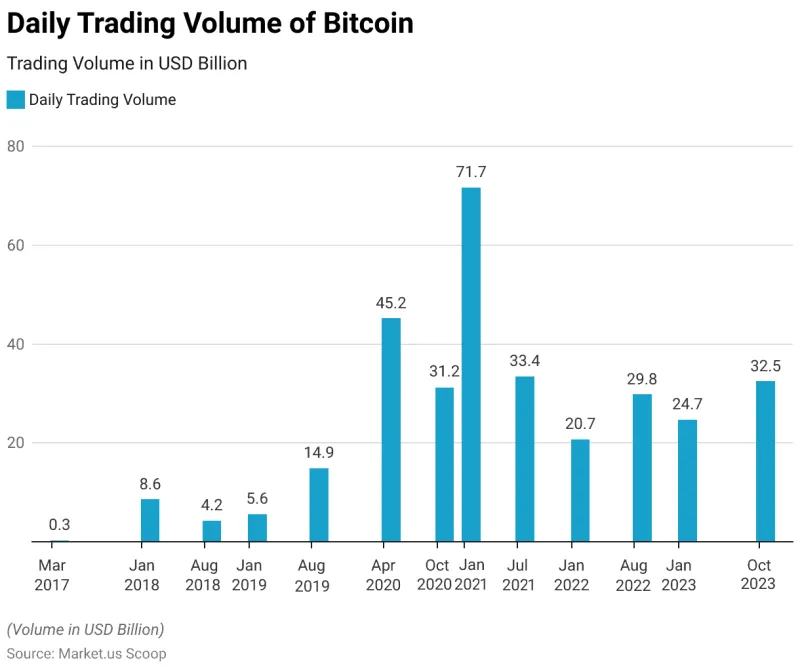
Photo: bitcoin trading volume chart stablecoin cryptocurrency market data analysis, via scoop.market.us
Volume is supposed to confirm price. When Bitcoin rallies on high volume, the standard technical interpretation is that the move has conviction behind it—that genuine buyers are deploying capital and that the directional signal is reliable. This logic holds reasonably well in traditional equity markets, where the relationship between volume and capital deployment is relatively direct.
In Bitcoin markets, the relationship is considerably more complicated. A meaningful portion of what registers as Bitcoin trading volume on any given day represents not fresh capital entering the market but existing capital rotating between Bitcoin and stablecoins—a cycle that produces volume figures without necessarily reflecting any change in overall market positioning or directional conviction.
For traders who rely on volume as a confirmation signal, this distinction is not academic. Acting on phantom volume as though it represents genuine buying pressure is a reliable path to poorly timed entries and unnecessary losses.
How Stablecoin Rotation Creates Phantom Volume
The mechanics of stablecoin rotation volume are straightforward once the participant behavior is understood. A trader holding $10 million in USDC who converts to Bitcoin and then reconverts to USDC within a 24-hour period will register $20 million in trading volume across two transactions. No new capital has entered the Bitcoin market. The trader's net position at the end of the cycle may be identical to their position at the beginning. Yet the volume figures generated by this activity are indistinguishable, on their face, from $20 million in directional capital deployment.
This effect is amplified when multiple traders engage in similar rotation behavior simultaneously—a pattern that tends to cluster around specific catalysts: macroeconomic announcements, regulatory news, or technical levels that prompt widespread reassessment of short-term positioning without necessarily resolving into a directional consensus.
The result is what might be called a stablecoin rotation phantom: a volume spike that appears on charts as a significant market event but that reflects, in substance, collective indecision rather than conviction.
Why Technical Analysts Systematically Misread This Signal
Standard technical analysis frameworks were developed primarily in equity and futures markets where the stablecoin rotation dynamic does not exist in its current form. The volume indicators embedded in most charting platforms—on-balance volume, volume-weighted average price, volume profile distributions—aggregate all transactional activity without distinguishing between directional trades and rotation cycles.
When a technical analyst observes a volume spike accompanying a price move and interprets it as confirmation of trend strength, they are working from an assumption that the volume represents net buying or net selling pressure. In a market with significant stablecoin participation, this assumption fails with measurable regularity.
The problem is particularly acute in US trading sessions, where stablecoin-denominated trading pairs account for a dominant share of overall Bitcoin volume on major exchanges. The USDT and USDC pairs that US-accessible exchanges list as their primary Bitcoin markets are precisely the pairs through which rotation volume flows most heavily.
On-Chain Metrics That Reveal the Difference
Distinguishing real capital deployment from rotation noise requires supplementing exchange volume data with on-chain indicators that reflect actual movement of capital rather than trading pair activity.
Stablecoin exchange inflows represent one of the most reliable indicators of genuine buying pressure. When new stablecoin deposits arrive at exchange addresses from external wallets—rather than circulating within the exchange ecosystem—they indicate that capital previously held off-exchange is being mobilized for deployment. This is categorically different from the rotation activity of capital already resident on the exchange.
Monitoring the ratio of new stablecoin inflows to total stablecoin exchange volume provides a practical filter. When this ratio is low—meaning that most stablecoin volume is circulating internally rather than arriving from external sources—the probability that associated Bitcoin volume reflects genuine buying pressure decreases.
Bitcoin exchange outflows provide a complementary signal. When Bitcoin leaves exchanges and moves to cold storage addresses following a price move, it suggests that buyers intend to hold their positions rather than continue trading. Volume accompanied by exchange outflows carries stronger directional conviction than volume accompanied by stable or rising exchange reserves.
Tether treasury mint activity offers a forward-looking indicator. Newly minted USDT represents fresh dollar-equivalent capital entering the stablecoin ecosystem, which historically precedes periods of genuine Bitcoin buying pressure. Absence of new minting during a volume spike suggests that the volume is being generated by existing stablecoin balances rotating rather than by new capital deployment.
A Practical Filtering Methodology
The following approach provides a structured method for evaluating whether any given Bitcoin volume event reflects genuine market conviction.
Step one: Establish the baseline rotation rate. For any exchange or trading pair you monitor regularly, track the historical ratio of new stablecoin inflows to total stablecoin volume over a rolling 30-day period. This establishes a baseline that allows you to identify deviations.
Step two: Compare exchange inflow timing to volume spikes. Genuine buying events are typically preceded or accompanied by stablecoin inflows from external addresses. If a volume spike occurs without a corresponding increase in stablecoin exchange inflows, the rotation explanation becomes more likely.
Step three: Evaluate post-move exchange reserve changes. A volume spike that leaves Bitcoin exchange reserves unchanged or higher suggests that buyers and sellers were both operating on-exchange, consistent with rotation activity. A volume spike accompanied by declining exchange reserves suggests that net buyers were moving coins into self-custody, consistent with directional conviction.
Step four: Cross-reference derivatives positioning. Genuine capital deployment into Bitcoin spot markets tends to be accompanied by changes in futures open interest. Volume spikes that occur without meaningful changes in open interest are more likely to represent rotation than new directional positioning.
Recalibrating Your Volume Interpretation
The practical implication of this analysis is that volume, used in isolation, is a less reliable confirmation signal in Bitcoin markets than most technical analysis frameworks assume. Traders who have been using volume spikes as entry triggers without filtering for rotation noise have been working with a systematically degraded signal.
The correction is not to abandon volume analysis—it remains informative when interpreted correctly—but to develop the habit of cross-referencing exchange volume data with on-chain indicators before drawing conclusions about market conviction. The additional analytical step is modest. The improvement in signal quality is material.
In a market where stablecoins now represent a structural feature of the trading ecosystem rather than a marginal participant category, reading volume without accounting for rotation dynamics is equivalent to reading price without accounting for liquidity. The number is visible. What it actually means requires more careful examination.